
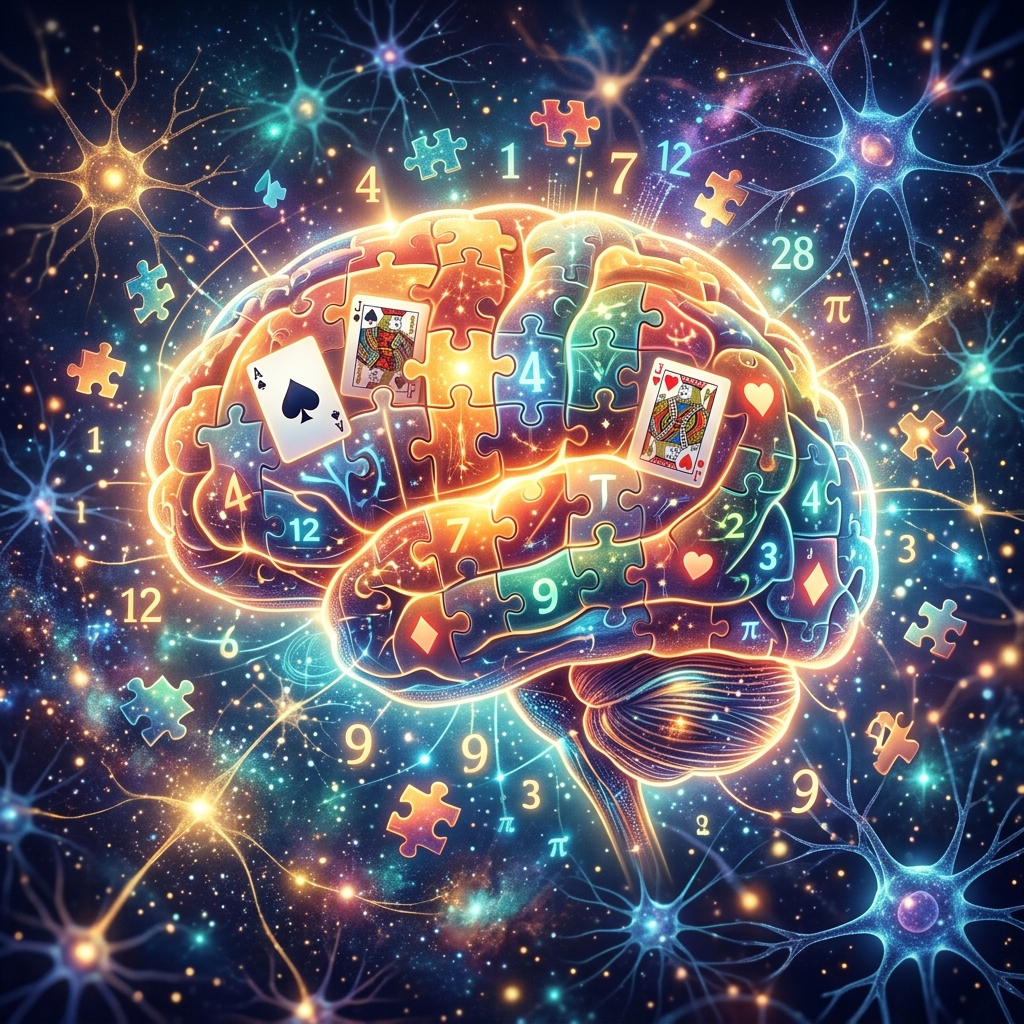
How Puzzle Games Improve Cognitive Health and Focus
Alex Carter is an indie game developer and puzzle enthusiast based in London, UK. He founded Ductgames in 2025 with the goal of making classic browser games accessible to everyone.
We often think of video games purely as entertainment, a way to pass the time or unwind after a long day. However, a growing body of scientific research suggests that certain types of games—specifically puzzle and logic games—can act as powerful tools for maintaining and improving cognitive health.
The Brain as a Muscle
Neurologists often compare the human brain to a muscle: if you don't use it, you lose it. Engaging in activities that require deep thought, spatial reasoning, and memory recall helps build new neural pathways. This concept, known as neuroplasticity, is the core reason why daily "brain training" through puzzle games is highly recommended for people of all ages.
Spatial Reasoning and Mathematics: 2048
Consider the massively popular game 2048. It appears simple at first glance—sliding tiles to combine numbers. But beneath the surface, it requires players to calculate probabilities, plan several moves ahead, and mentally map out the spatial arrangement of the board. Playing 2048 regularly exercises the prefrontal cortex, the area of the brain responsible for complex planning and decision making.
Short-Term Memory Retention: Memory Match
Another excellent cognitive exercise is Memory Match. The mechanics force the player to actively hold visual information in their short-term working memory while processing new visual stimuli. As you progress to larger grids (like the 5x6 layout), the cognitive load increases, providing a rigorous workout for the hippocampus—the brain region critical for learning and memory formation.
The Flow State and Stress Reduction
Beyond building brain power, puzzle games are uniquely adept at inducing a psychological "flow state." When a player is completely absorbed in solving a puzzle, outside anxieties and stressors fade away. This focused relaxation can lower cortisol levels and provide significant mental health benefits, proving that taking a 10-minute break to play a browser game isn't a distraction—it's active mental wellness.
The Science: What Research Actually Says
While critics once dismissed casual video games as simple distractions, modern cognitive neuroscience presents a very different picture. A landmark 2014 study conducted at the University of Iowa, published in the journal PLOS ONE, demonstrated that playing logic and puzzle games for just ten hours could slow the natural cognitive decline in adults over the age of fifty by up to seven years. Furthermore, research from Cambridge Brain Sciences has shown that targeted mental exercises directly stimulate the brain's prefrontal cortex and hippocampus, leading to measurable improvements in working memory, spatial reasoning, and visual search efficiency. These studies confirm that engaging in structured logic challenges helps maintain the brain's neural density, creating a robust cognitive reserve that protects against age-related decline. By actively challenging the brain with novel rules and spatial configurations, players can build new synaptic connections that improve executive function and information processing speed in daily life.
Recommended Daily Routine: 15 Minutes of Play
To maximize the cognitive benefits of puzzle games, you do not need to spend hours playing. Instead, a focused daily routine of just fifteen minutes can provide an optimal mental workout. Start with a five-minute round of Sudoku to warm up your logical deduction skills and number placement strategies. Next, transition to a five-minute session of Memory Match to exercise your short-term visual recall and spatial mapping capabilities as the card grid empties. Finally, finish with five minutes of 2048 to challenge your long-range strategic planning and probability calculations. This balanced, multi-genre approach ensures that you stimulate different cognitive areas, keeping your brain sharp, focused, and ready to tackle complex real-world tasks.
Age Groups and Benefits
The cognitive enhancements of daily puzzle play extend across all stages of life, benefiting children, adults, and seniors in unique ways. For children, classic logic grids and pattern games build foundational spatial reasoning, enhance visual working memory, and teach systematic problem-solving skills that support mathematical learning. For working adults, a brief session of puzzle gaming acts as a healthy form of stress relief, inducing a focused flow state that lowers cortisol levels while improving task-switching abilities. Finally, for seniors, playing these games serves as a critical tool for cognitive maintenance, exercising memory retrieval pathways and visual scanning speeds to delay the onset of mild memory impairment and support independence.
Conclusion
In conclusion, puzzle games are far more than a casual source of entertainment; they are a scientifically validated exercise system for the human mind. By stimulating neuroplasticity, improving working memory, and offering custom routines, these simple browser-based games provide a powerful cognitive workout. At Ductgames, we build free, instant-access titles like Sudoku, Memory Match, 2048, and Tic Tac Toe to make daily mental wellness accessible to everyone. Taking a fifteen-minute break to challenge your brain is a valuable investment in your long-term cognitive health. Visit our games page, choose your challenge, and start your daily mental workout today.