
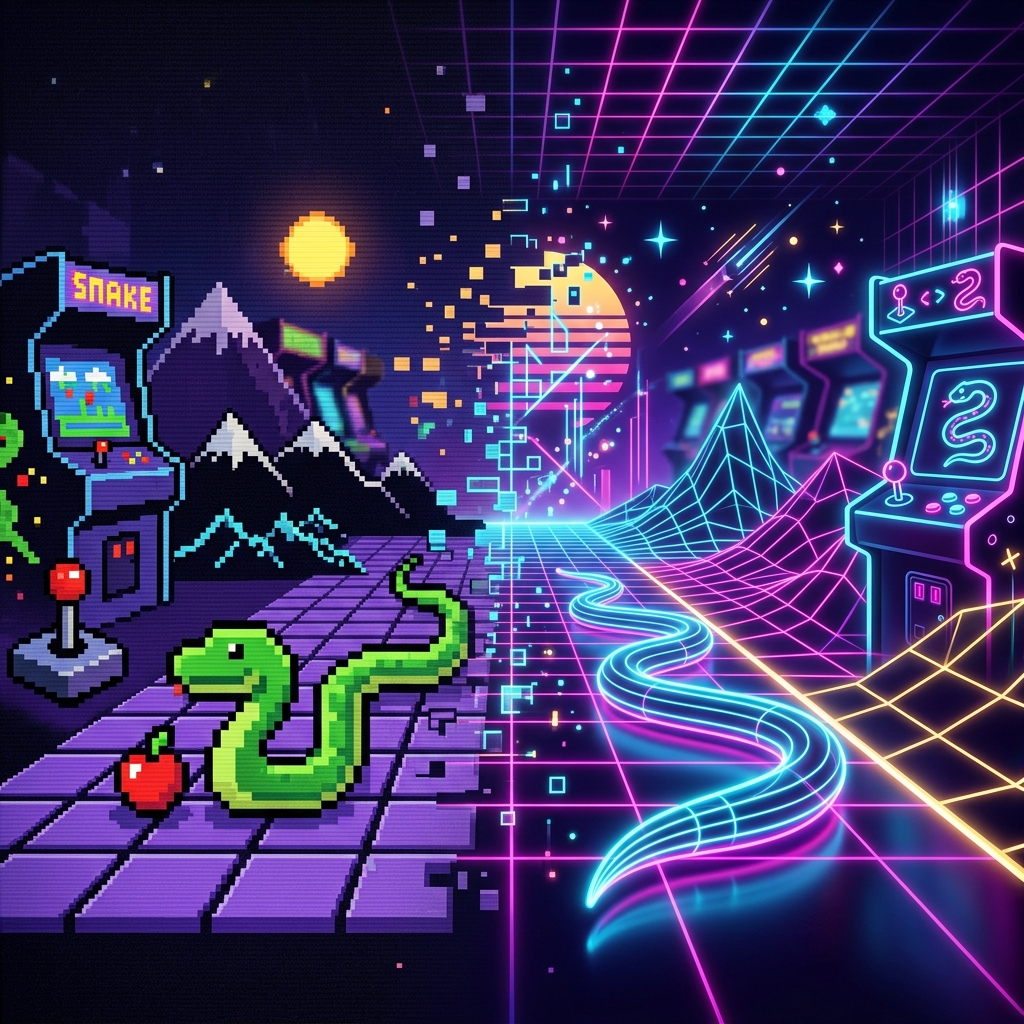
The History of Snake: From Nokia to Browser
Few video games are as universally recognized or as deeply nostalgic as Snake. For millions of people around the globe, the mere mention of the game conjures vivid memories of green-lit, low-resolution LCD screens, tactile plastic buttons, and the addictive pursuit of a pixelated dot. But the story of Snake is much richer than a simple mobile phone distraction. It is a tale that spans over five decades, tracing its roots from the smoke-filled arcade halls of the mid-1970s, through the mobile revolution of the late 1990s, to its modern renaissance as an instant HTML5 browser game. By exploring the history of Snake, we can see how a simple concept evolved alongside hardware technology to become a timeless classic of digital entertainment.
Arcade Beginnings in the 1970s
While many associate Snake with Nokia, its true origin lies in the arcade boom of the 1970s. The game's core concept was introduced in 1976 by Gremlin Industries with the release of an arcade cabinet titled Blockade. Unlike the single-player game we know today, Blockade was a two-player competitive game. Each player controlled a line that grew longer as it moved across a grid. The goal was to maneuver your line to trap the opponent, forcing them to crash into a wall or a trail. Blockade was a hit, and it quickly inspired clones. In 1977, Atari released a similar game called Surround for the Atari 2600 console. In 1978, the single-player version of the game began to take shape. Macintosh's early systems and computers like the TRS-80 hosted titles like Worm and Hustle, where a single player controlled a snake that grew longer by eating items spawned randomly on the screen. The mechanics were simple: eat, grow, survive. The game loop was born.
The Nokia Era and Mobile Revolution
For nearly twenty years, Snake remained a popular but niche game on early home computers. That changed forever in 1997. Nokia, a Finnish telecommunications giant, was preparing to launch the Nokia 6110. A system engineer named Taneli Armanto was tasked with finding a game that could showcase the phone's new infrared connection capabilities. Seeking a game that was easy to learn but hard to master, Armanto recalled the classic arcade snake games. He programmed a single-player version of Snake for the phone's 84x48 pixel monochrome display.
The response was historic. The Nokia 6110 became an overnight sensation, and Snake was its killer app. It was pre-installed on hundreds of millions of Nokia handsets, including the legendary Nokia 3210 and 3310. It became a cultural touchstone of the late 90s and early 2000s. People competed for high scores in schoolyards, offices, and homes. Nokia updated the game with Snake II (introducing mazes and wrap-around walls) and Snake EX (introducing color graphics). Armanto's simple mobile adaptation transformed Snake into one of the most played video games in human history.
Paving the Way for Mobile Gaming
Before Nokia put Snake on the 6110, mobile phones were viewed strictly as utility devices for business calls and text messages. Snake proved that mobile phones could be powerful personal entertainment platforms. It paved the way for the entire mobile gaming industry, showing that games did not need console-grade graphics to be incredibly addictive. Without the success of Snake, the path to modern mobile sensations like Angry Birds or Candy Crush might have looked very different. It established mobile gaming as a legitimate, highly lucrative market.
The HTML5 Renaissance
Today, Snake has entered a new era. With the official discontinuation of Adobe Flash in 2020, web developers turned to HTML5 to keep retro games alive. In this modern era, HTML5 browser-based games have sparked a renaissance for classics. Utilizing the Canvas API and modern JavaScript, developers have rebuilt Snake to run smoothly on any modern device.
Modern HTML5 versions of Snake offer features that early mobile developers could only dream of. Players can toggle between slow, normal, and fast speeds, play with responsive touch-screen D-pads on mobile browsers, and enjoy vibrant graphics with glowing visual effects. Yet, despite these upgrades, the gameplay remains exactly the same as it was in 1976. The enduring legacy of Snake is its simplicity. It requires no complex tutorials or extensive time commitments—just immediate, retro fun available at the click of a button.
Conclusion
From its origins in the early arcades, to the monochrome Nokia screens, and now to the modern open web, Snake has proven to be an indestructible classic. It is a game that transcends generations, offering the same pure, addictive fun to browser gamers in 2026 as it did to arcade players in 1976. At Ductgames, we are proud to host this piece of gaming history, keeping the legacy of Snake alive for players to enjoy instantly, for free, on any device. Check out our free, instant-play Snake Game Page to test your reflexes and set a new high score today!