
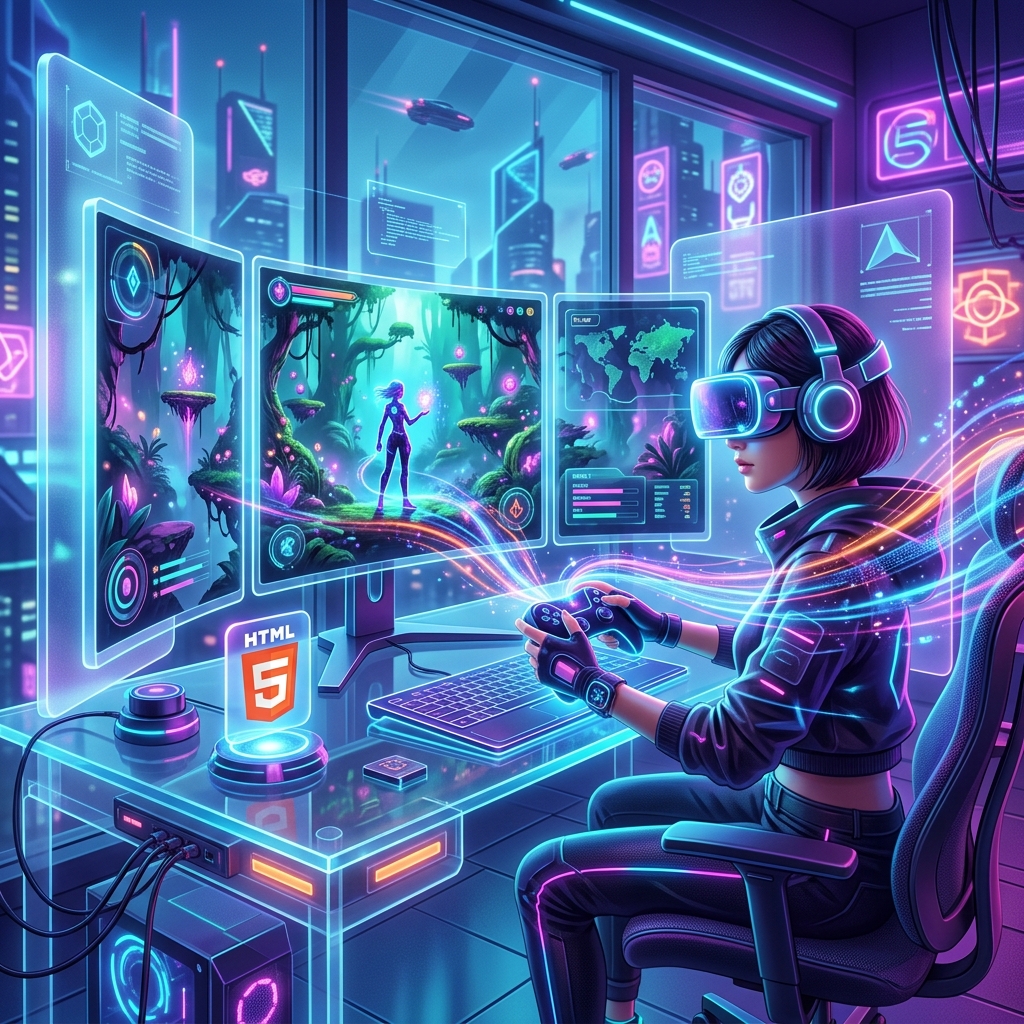
Why HTML5 Games Are the Future of Casual Gaming
Alex Carter is an indie game developer and puzzle enthusiast based in London, UK. He founded Ductgames in 2025 with the goal of making classic browser games accessible to everyone.
The digital entertainment landscape is undergoing a massive shift. While high-end console and PC titles push hardware boundaries with heavy graphic pipelines, a quiet revolution has taken root: the rise of HTML5 browser games.
Gone are the days when playing a quick game meant downloading a bulky app, navigating complex app store ecosystems, or updating obsolete flash plugins. Today, HTML5 has made gaming frictionless. According to a gaming industry report by Newzoo [1], casual games continue to lead mobile and web engagement, capturing billions of players worldwide. The foundation of this mass engagement is the technology powering it: HTML5. Over the last five years, HTML5 has completely transformed web development. By blending HTML markup, CSS styling, and JavaScript logic, it enables rich multimedia experiences natively inside the browser. No downloads, no installs, no sign-ups. It is instant, lightweight, and incredibly secure. As web standards evolve, HTML5 games are not just matching the features of native mobile apps; they are surpassing them.
1. The Power of Instant Play
In a world defined by micro-interactions, friction is the ultimate enemy of user acquisition. Under old distribution models, if a player wanted to try a new casual game, they had to browse an app store, enter credentials, wait for a download, accept extensive permissions, and install the file. This process introduces multiple points where potential players drop off. HTML5 removes this friction entirely. Built on standard web pages, a game starts playing the millisecond a link is clicked. A study by Google Web Fundamentals [2] highlights that every additional second of load time can decrease conversion rates by up to 20%. By utilizing modern browser caching, HTTP/2 multiplexing, and lightweight vector assets, HTML5 games load almost instantaneously. For players with only five minutes to spare—whether they are commuting, on a lunch break, or relaxing at home—instant play makes gaming immediately accessible, fitting seamlessly into the gaps of our busy daily schedules.
2. True Cross-Platform Compatibility
Historically, game developers had to build entirely separate codebases to deploy on different operating systems. A mobile game required Objective-C or Swift for iOS, Java or Kotlin for Android, and C# or C++ for Windows. This fragmented development cycle multiplied production costs and lengthened testing phases. HTML5 solves this with a write-once, run-anywhere paradigm. An HTML5 game is essentially a responsive web application that runs inside a standard browser engine. Because modern web browsers on iPhone, Android, tablets, and computers all adhere to unified W3C standards [3], developers can deploy the exact same code across all platforms. Using CSS Grid, flexbox, and canvas viewport scaling, the game interface automatically adjusts to fit any resolution, from a 5-inch phone screen to a 32-inch 4K monitor. The player's experience remains identical, whether they are tapping on a touchscreen or using a keyboard and mouse on a desktop.
3. Zero Storage Space Required
Smartphone users are constantly managing limited storage capacities. Between high-resolution photographs, videos, and heavy social media applications, device storage space is a premium asset. Casual mobile games from app stores can easily take up 100MB to 500MB of space, making users reluctant to download games they might only play occasionally. HTML5 browser games require absolutely zero permanent storage space on the player's device. When a user navigates to a game like 2048 or Snake on Ductgames, the browser downloads the game assets directly into its temporary RAM and cache. Once the browser tab is closed, that space is automatically freed. This enables casual gamers to explore dozens of different titles without worrying about storage limits. It also allows developers to push instant content updates, ensuring that users always play the latest version without needing to download manual updates or app store patches.
4. The Death of Flash and the Rise of Security
For over two decades, browser gaming was powered by Adobe Flash. Flash enabled iconic games that defined the early internet. However, Flash was also plagued by critical security vulnerabilities, heavy CPU usage, and high battery consumption. The ultimate death of Flash in December 2020 marked the end of an era, but it opened the door for a much superior standard. Unlike Flash, which required third-party plugins that ran in separate processes, HTML5 is built directly into the open web standards supported natively by browser rendering engines. This native integration provides significant security benefits. HTML5 games run within the browser's sandbox environment, preventing them from accessing sensitive system files or local data without explicit permission. Furthermore, HTML5 utilizes the hardware-accelerated Canvas 2D and WebGL APIs, which are highly optimized for CPU usage and battery efficiency on mobile processors, delivering high-frame-rate performance without draining the device's battery.
5. Advanced Web APIs: Pushing Technical Boundaries
A common misconception is that browser-based games are limited to simple, pixelated graphics and basic sound effects. In reality, modern web technologies support highly advanced Web APIs that match the capabilities of native software. For instance, the WebGL 2.0 API gives developers direct access to the graphics card, allowing for hardware-accelerated 3D graphics and complex shader effects directly in the viewport. The Web Audio API provides professional-grade audio synthesis, enabling dynamic spatial audio positioning and real-time audio manipulation. Furthermore, the introduction of WebAssembly (Wasm) has allowed developers to compile code written in high-performance languages like C++ or Rust directly into web-executable modules, running CPU-intensive game loops at near-native speeds. These technologies mean that browser games can offer complex physics, rich audio design, and stunning visual layouts that load in seconds.
6. The Direct-to-Consumer Distribution Revolution
App stores have long acted as gatekeepers of digital distribution, enforcing strict approval processes, guidelines, and taking a hefty 30% revenue share on purchases. For independent developers and small gaming platforms, these barriers make it difficult to survive and reach audiences. HTML5 games bypass these gatekeepers entirely. Because they are hosted on standard web servers, developers can publish their games directly to consumers. Sharing a game is as simple as sharing a URL on social media, messaging platforms, or email. This open model has fueled the rise of instant gaming platforms inside messaging apps like Telegram, Discord, and Facebook. It also allows platforms like Ductgames to host a curated collection of premium web games, offering monetization through non-intrusive web ads without paying commissions to app store monopolies.
The WebGL and Canvas API Advantage
One of the most important technical milestones for web browser gaming has been the widespread adoption of modern rendering APIs. Historically, web browsers struggled to display complex animations or high frame rates. Today, modern browsers leverage the user's graphics processing unit (GPU) to run games smoothly via Canvas 2D and the WebGL (Web Graphics Library) API. Canvas 2D is ideal for handling grid-based arcade layouts, while WebGL handles hardware-accelerated 3D rendering and shader calculations directly in the browser viewport. By offloading these intensive graphics computations to the GPU, HTML5 games can run at a stable 60 frames per second, matching the performance, fluidity, and visual output of native desktop and mobile applications without draining the device's battery.
HTML5 vs Native Apps: The Data
When comparing web games to native app downloads, the conversion metrics and user engagement data favor the browser experience. According to the 2023 Newzoo Mobile Gaming Report, mobile users spent an average of 30 minutes per day playing casual browser-based games, indicating a strong appetite for instant play. Additionally, the data shows that removing the requirement of visiting an app store and downloading files reduces player drop-off by up to 60%. Friction is the primary reason why users abandon native apps before their first session. By offering a direct link that opens the game instantly in any browser tab, HTML5 platforms capture audience attention immediately, maximizing conversion rates and building a much higher viral sharing coefficient than traditional app storefronts.
The Future: PWA and Offline Play
The technical evolution of browser gaming is accelerating with the introduction of Progressive Web Apps (PWAs) and Service Workers. Historically, browser games had a critical weakness: they required an active internet connection to load and play. PWAs solve this issue by allowing web applications to be installed directly onto a user's home screen, functioning like native apps. Behind the scenes, Service Workers intercept network requests and cache essential game assets (like JavaScript bundles, stylesheets, and audio files) locally on the device. This means that once a player loads a game on Ductgames, they can return and play it fully offline, even during a flight or in areas with poor cellular service, matching the offline availability of native apps.
Conclusion
In summary, the transition from heavy app store installations to frictionless, high-performance web environments represents the logical future of casual gaming. By leveraging GPU acceleration, bypassing native store gatekeepers, and implementing offline PWA capabilities, HTML5 games deliver a premium experience that respects both the player's time and their device's storage limits. At Ductgames, we remain dedicated to building and optimizing classic titles like Tic Tac Toe, Snake, 2048, and Sudoku, providing instant access to visual excellence. The open web is the new console, and your next gaming adventure is just a single click away. Check out our full library of free HTML5 games right now, and start playing immediately.
- Newzoo Global Games Market Report — newzoo.com
- Google Web Fundamentals & Core Web Vitals Studies — web.dev
- W3C Web Applications Standards Group — w3.org